




by Jake Cline
"The hurricane came with great suddenness," Richard Gray, of the Miami Weather Bureau Office, wrote in his on-the-scene report of the Great Miami Hurricane of 1926, also known as the Big Blow. It was, Gray noted, "probably the most destructive storm in the history of the United States" at that time.
In the predawn hours of September 18, the Category 4 storm made landfall on Miami Beach. It pushed the ocean into homes and hotels, knocked out telephone service across the area, hurled boats from Biscayne Bay onto the streets of downtown Miami and left automobiles—and, in some tragic cases, their occupants—buried in sand. More than 100 people died, tens of thousands were left homeless and property damage totaled, according to PBS, the equivalent of $1.5 billion in today's currency.
"The intensity of the storm and the wreckage that it left cannot adequately be described," Gray wrote, and then endeavored to describe it, anyway: "The continuous roar of the wind; the crash of falling buildings, flying debris and plate glass; the shriek of fire apparatus and ambulances that rendered assistance until the streets became impassable; the terrifically driven rain that came in sheets as dense as fog; the electric flashes from live wires have left the memory of a fearful night in the minds of the many thousands that were in the storm area."
Even though he was born nearly a half century later, Jorge Mejia has thought often about that night. In the early 2000s, Mejia, a Latin Grammy-nominated composer, pianist and music executive, lived in an apartment building that had been erected just four years before the hurricane struck. The boxy, two-story residence sits about a block from the ocean at 221 Collins Avenue, making it among the first structures in Florida to have been hit by the storm's winds, which Gray estimated reached up to 150 miles per hour.
Whatever damage the building sustained was not permanent, and 221 Collins has withstood a century's worth of storms, developers and gentrifiers. It has provided a home to an untold number of tenants, many of whom no doubt arrived from outside Florida. The building has operated as a hotel and provided temporary housing for soldiers and their families during World War II.
"I mean, all the history that that building went through," Mejia says during a recent phone interview. "You kind of felt it. The floors were Dade County pine, which you can't get anymore. It just had a very nice feeling to it. I always thought, 'I wonder who else lived in this apartment, and I wish I could tell their story.' "
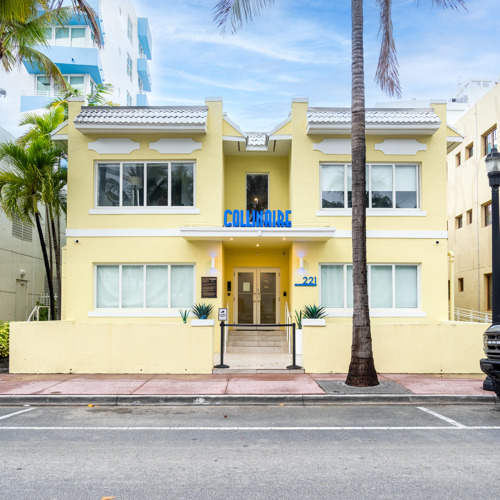
This month, Mejia will release If These Walls Could Talk, a multimedia album that features a piano concerto inspired by 221 Collins and recorded with the London Symphony Orchestra at the famed Abbey Road Studios. Mejia will issue the album, which also includes six original sextets arranged for piano and strings, April 24 on Apple Music and May 8 on other platforms. On April 26, Mejia will perform the concerto's US premiere at the Adrienne Arsht Center during An Evening of Masterpieces and a Piano Concerto with the Frost Symphony Orchestra and conductor Gerard Schwarz. The program also includes Ravel's "Alborada del gracioso" and Shostakovich's Symphony No. 10 in E minor.
"The narratives to me are bridges to the music, and vice versa," Mejia says of the project's literary component. "And part of the intent here is that in this day and age, asking somebody to listen to something that lasts 20 minutes that's new is a big lift. And I think that the narratives help line the way or are bridges to it. They serve as a way to connect the dots, if you will, to the music."
Mejia, who says he has filled "millions of journals" with his writing, first paired narrative storytelling with music in 2018 with an ebook and album titled An Open Book: A Memoir in Music, recorded with the University of Miami's Henry Mancini Orchestra. (Mejia is a graduate of the university's Frost School of Music; he also studied piano at New World School of the Arts and the New England Conservatory in Boston.) The album's opening number, "Prelude in F major for Piano and Orchestra," earned Mejia a Latin Grammy Award nomination for Best Classical Contemporary Composition.
While the concerto can be appreciated independently of the stories, Mejia has invested his characters with detailed backgrounds and authentic personal lives. Like many South Florida residents, including the Colombian-born Mejia, the characters hail from another state or country or are the children of immigrants. An economical writer, Mejia conveys the sweep of these people's lives in short, impressionistic sentences that steer away from cynicism and toward melancholy and even romance. The music, which Mejia says he wrote before the text, can be appropriately dramatic, as exemplified by its arresting first movement, or "First Floor."
"The first movement is that hurricane," Mejia confirms. "There's actually a part of it that's the eye, and you can tell that that's what it is if you know what to look for."
With If These Walls Could Talk, Mejia is not simply aiming to revisit a personally significant era from his past or guide listeners and readers through a sepia-toned tour of South Florida history. To be sure, those aspects are inherent in the work, but Mejia says the concerto and its accompanying text carry an urgent message about the city's present and its future.
"Miami's built by people who have come here looking to make something of themselves in a place that barely exists, or barely existed. It's becoming more and more tangible," he says.
"I'm careful about using the loaded word immigrant, but it's a place [where] we've all come from so many different places. And we've all built [it]. It's also a place that is still able to be built. Not everything has been said yet here. We still have a chance to create its history, its story. When you think about other cities that have longer histories, like New York, Chicago, it's harder to build this city. But here we can still have a hand in shaping this particular city."
An Evening of Masterpieces and a Piano Concerto will take place 7 p.m. Sunday, April 26, 2026 at the Knight Concert Hall. Tickets are available here.