




by Jake Cline
René Robert's death in 2022 was international news, with outlets from The New York Times to The Guardian and El País reporting on the "appalling" and "shocking" circumstance of the Swiss photographer's end. Although famous in the world of flamenco, whose artists he had documented in dynamic black-and-white images for more than 50 years, Robert was little known outside it. That fact was cruelly underscored by the manner in which he died: While walking along a crowded Paris street early on a January evening, the 85-year-old fell to the ground and lay there for the next nine hours, as passersby stepped around the man they presumably mistook for one of the city's many unhoused residents. By the time a pair of actual homeless citizens came to his aid and called for an ambulance, Robert was hypothermic. He died soon after in a hospital.
No doubt, the scandalous nature of Robert's death is why many people became aware of the photographer and why they may remember him still. It's an understandable but difficult idea for longtime fans of Robert's work, which dates to the 1960s and features some of the biggest names in flamenco.
"On the internet, if you search for his name, you will get his death but not his art," choreographer José Manuel Álvarez says during a phone interview from his home in Barcelona. Álvarez, speaking through an interpreter, recalls meeting Robert at a flamenco festival in Paris, where the photographer lived for decades and where he saw his first flamenco performance.
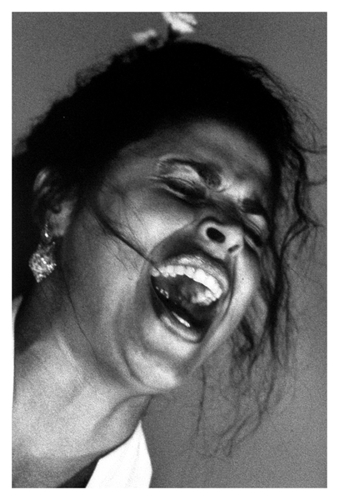
Favoring heavily shadowed, black-and-white action shots, Robert often photographed his subjects in extreme close-up. He filled his frames with the taut, upper bodies of dancers, their arms coiled above their heads. He seemed especially drawn to singers at their most ecstatic, with their eyes shut tight and mouths wide open.
Such expressions of life, and the promise of them, are the central interest of Álvarez's new show, Captura y Fuga, which the Arsht and Siudy Flamenco Company will present Sunday, June 14 at the Carnival Studio Theater. The multimedia work premiered last year and incorporates photographs from throughout Robert's career, including photos that were among the first he shot at Le Catalan, the Parisian venue where he discovered many of his subjects.
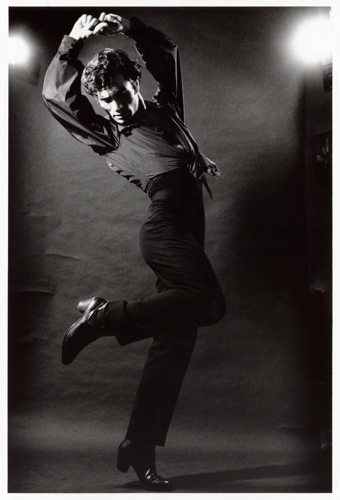
Following Robert's death, Álvarez was granted permission to explore the photographer's archive at the Bibliothèque Nationale de France. He was overwhelmed by the volume of images he found within a half century's worth of "folders and folders and folders." Many of the photos, Álvarez says, have never been seen by the public. "For me, it was the discovery of a treasure," he says. "It was like, 'Oh, my God, what I just found here, what do I do with this?' "
In Captura y Fuga, Álvarez dances while Robert's photographs appear on-screen behind him. The choreographer presents the images in chronological order to represent the progression of Robert's art along with the evolution of modern flamenco. The performance also leans into the metaphor of a photograph being developed in a darkroom, with light and life emerging from the shadows. Robert shot on film, processed his own photos and shied away from digital cameras.
One number in the show, "Retention," combines photos of traditional flamenco masters such as Antonio Gades with those of more contemporary dancers such as Israel Galván and Andrés Marín. Álvarez says the images "retain" the essence of a body in motion and points out that "retention" is also a method of film processing. "It's going to appear as if you're watching a photograph develop," he says.
Álvarez explains that Robert decided to concentrate on photographing flamenco artists in performance after a portrait session at the home of Manolo Marín, a Spanish dancer he met at Le Catalan. "He discovered that he didn't want to work in the studio but wanted to work live," Álvarez says, "and he never went into a studio again."
During his brief interaction with Robert in Paris, Álvarez says the photographer lived up to his reputation as a shy but agreeable man who worked quietly. "He was very discreet with his camera because he did not want to intimidate [people] with the lens," Álvarez says. "He was a very polite gentleman."
His photos, meanwhile, are anything but reserved. Captura y Fuga features Robert's iconic shot of Aurora Vargas, a singer from Seville depicted in full rapture onstage. Álvarez says the image represents the vitality of Robert's art and exemplifies why he ignores the photographer's tragic death in his show.
"That photo is incredible," says Álvarez, who had it printed onto his Captura y Fuga wardrobe. "That photo is intense. That photo has duende. It looks like a lion with its mouth open. It's a wild thing."
Captura y Fuga by José Manuel Álvarez will begin 5 p.m. Sunday, June 14 at the Carnival Studio Theater. Tickets cost $76.05. Álvarez is also participating in The Creative Process – Flamenco Beyond Tradition, a weeklong residency hosted by Siudy Flamenco that culminates June 13 in a showcase at the Carnival Studio Theater.
Top: Photo courtesy José Manuel Álvarez and Siudy Flamenco Company.