




by Jake Cline
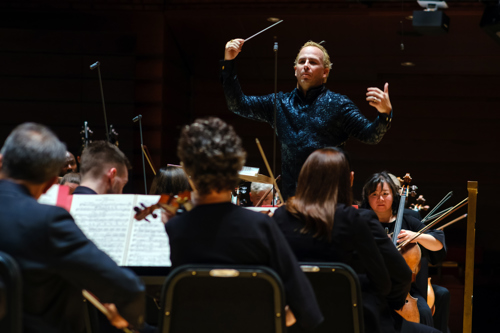
Yannick Nézet-Séguin, perhaps the world's most famous living conductor and certainly its busiest, will make his Miami debut Thursday night at the Adrienne Arsht Center. "In a way, it's about time," says the 50-year-old Montreal native, whose only previous Florida performances until this week included a last-minute appearance four years ago with the Vienna Philharmonic Orchestra in Naples and two guest turns at the podium with the Sarasota Opera in 2002 and 2003. With The Philadelphia Orchestra, where he has served nearly 15 years as music director and three years as artistic director, Nézet-Séguin will conduct Brahms' Third and Fourth Symphonies inside the Knight Concert Hall.
"I've never had the chance to visit [Florida] with The Philadelphia Orchestra, and they visit quite regularly," he says. "I'm very excited to finally be able to join them there."
A simple glance at Nézet-Séguin's résumé can help to explain why he hasn't conducted at the Arsht until now. In addition to his job in Philadelphia, Nézet-Séguin has been music director of the Metropolitan Opera in New York since 2018 and music director and principal conductor of Montreal's Orchestre Métropolitain since 2000. He frequently guest-conducts with orchestras across the globe, including the Chamber Orchestra of Europe, the Berlin Philharmonic, the Rotterdam Philharmonic and the Vienna Philharmonic, whose annual New Year's concert he conducted this year for an estimated worldwide audience of 50 million people. He worked as a consultant on Bradley Cooper's Academy Award-nominated 2023 Leonard Bernstein biopic Maestro. His numerous recordings with The Philadelphia Orchestra and others have earned him 18 Grammy Award nominations and five wins. This year and next, he will lead three orchestras—Philadelphia, Vienna and the Metropolitan Opera—through Mahler's nine symphonies at Carnegie Hall.
Nézet-Séguin has been a powerful advocate for composers and communities whose work has long been ignored by classical music organizations and fans alike. In September 2021, he conducted Terence Blanchard's Fire Shut Up in My Bones, the first opera by a Black composer to appear at the Metropolitan Opera in the then 138-year-old company's history. Two years later, he conducted another Blanchard opera, Champion, at the Met. For the Philadelphia Orchestra's 2024-25 season, Nézet-Séguin commissioned a work by Indigenous Canadian composer Barbara Assiginaak.
(Of Blanchard, who coincidentally will play the Knight Concert Hall this Friday, Nézet-Séguin says, "Terence is just one of the absolute best people of our time and such a genuine trailblazer.")
Nézet-Séguin's bleached-blond hair, painted fingernails and flashy onstage outfits, meanwhile, have garnered no small amount of attention. He spoke to Arsht Magazine by phone last week.
The following exchange has been edited for length and clarity.
Why did you want to perform these particular Brahms symphonies on your tour of Florida?
I think any tour is an opportunity for an orchestra and a conductor to show what they can do together and what the chemistry is. And, of course, these pieces are iconic. They're part of the repertoire. A lot of what we do in Philadelphia is actually more adventurous, and we premiere a lot of works, but these pieces are far from that. But I just felt like—especially at this point in my relationship with the orchestra, which is now over 15 years—these pieces are a great opportunity to show how we interact together.
And basically for me, Brahms is my favorite composer. He's always been my favorite composer, even when I was a young student. I feel his music is the absolute combination of wonderful, classical perfection, but also a lot of humanity, a lot of emotion. And when I say, "humanity, emotion," I mean that there are some moments that are really grand and majestic, but others that are very, very intimate. And I hope that what the audiences in Florida will be able to see is how intimate we are with each other, you know the orchestra and myself, and we hope that we're going to be able to have the audience come on our journey together with us and rediscover these pieces through this lens or discover them if it's the first time that they hear them.
Brahms was the first composer you conducted, at 21 years old in front of a pickup orchestra.
Yes, it was his Requiem. Sometimes, I think that I started conducting because I wanted to be able to conduct that piece or conduct Brahms in general. It's been quite some time. That was in 1997. But there's a beauty in classical music and in orchestral music: These pieces are so vast and wonderful and beautiful that they can evolve. I'm a different person now, and in a way that's a little bit what I was saying about me and the orchestra. We fell in love with each other back in 2008, but now, fast-forward to 2026, we know each other so well that it has evolved. And hopefully, that's like any human relationship. Things evolve for the better, and we are different people, and we can bring something new to these pieces, even though we've been playing them for so long. There's never a routine about it, and that's what I love.
During the pandemic, you made a decision that when the world opened up again, you were going to program composers who had been underappreciated or underperformed: Florence Price, Valerie Coleman and others. In one interview, you compared redirecting an orchestra to turning an ocean liner. Have you seen other conductors and orchestras follow your lead? What kind of progress do you think has been made?
There's obviously still so much to do, but I've seen a lot of evolution, just in the mentality from arts organizations and musicians, orchestra musicians. Because of course, as a music director, artistic director of the Philadelphia Orchestra or the Met, I'm the one who can indicate where we're going. But I'm also nothing if the heart and soul of the musicians is not with me. So, therefore, I've seen these very encouraging signs—not only in my institutions, but also a little bit everywhere in the world. It is slowly but surely evolving, as everybody understands that if we all chime in, if we all do it a bit together and try to incorporate in our repertoire more new or underrepresented composers, that it doesn't detract from still playing Brahms, for example. But we can also just include more people.
I'm just out now, as I speak to you, from a rehearsal for the tour. And then, I had one of my lab orchestras that I do at Curtis Institute here [in Philadelphia]. One of my student conductors was conducting a piece by Gabriela Ortiz, and I was just watching how the musicians, the young musicians of the orchestra, they were just believing in this piece so much, and I got almost emotional, and I thanked them and said, "Look, a few years ago, this might have been something that was very foreign to you, and maybe not everyone would have loved to invest so much in this very difficult piece." But now, I could feel like they were all so invested in it, and I think that's the best sign that things will indeed evolve. "Change" maybe is a big word, but at least [things will] evolve for the better in the years to come.
This isn't exactly related to your question, but when you mentioned the ocean liner, that's also something I wanted to say specifically about Florida and Brahms. There's a lot, for me, of metaphor all the way through the Third Symphony, of waves and ocean and how it's coming down, how it's becoming more stormy at times. I told the musicians, "We're going to be near the ocean all the way through our tour. I hope this can inspire us to have that metaphoric connection when we play."
You've received much attention for what you wear when you're conducting. Do you have anything special planned for the Florida tour?
I did buy some new stuff specifically for this tour. It has a nod to tradition with the darker colors and everything, but hopefully it's fashionable. That's what I'm going after. Also, my choice of shoes we felt were a little more colorful and somewhat very chic, but playful at the same time. Where I play does influence a little bit how I dress.
The Philadelphia Orchestra will perform 8 p.m. Thursday, February 19 at the Knight Concert Hall. Tickets are available here.
Top: Photo by Landon Nordeman.